Nontoxic, stable X-ray detector materials for rapid, low-dose imaging

Image from Licence Details: Nontoxic, stable X-ray detector materials for rapid,  low-dose imaging
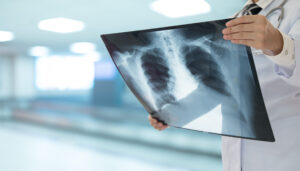
Applications: Low-dose radiography, Precise X-ray imaging, Portable X-ray devices, Industrial non-destructive testing, Security screening systems, X-ray video

Current X-ray detector materials cannot simultaneously deliver strong absorption, low noise and efficient charge transport at very low doses rates.

Researchers developed novel bismuth oxyiodide (BiOI) single crystals as high-performance materials for detecting very low dose of X-rays, a key capability for safer and more sensitive medical and industrial radiography.

Nature Communications 2023, 14, 2452.

Features Benefits
  • Low dose detection down to 22 nGyair·s⁻¹
  • Reduced patient and operator radiation exposure
  • New applications becomes feasible, such as X-ray videos
  • X-ray absorption (attenuation) enhanced through heavy elements bismuth and iodine, characterised for their strong X-ray stopping power
  • Reduction of detector thickness and system weight for compact and portable platforms
  • Direct conversion detection from X-rays to electrical signal
  • High spatial resolution and fast temporal response
  • Simple system architecture with no need for scintillation step
  • Low dark current and noise
  • Clear detection of weak signals
  • Lower power consumption
  • Improved image quality
  • Efficient charge transport via delocalised large polarons instead of self-trapping.
  • Absorbed X-rays reliably turn into usable electrical signals
  • Improved signal-to-noise ratio
  • Lead-free chemistry
  • Regulatory compatibility
  • Safe manufacturing and disposal

Patented and available for:

  • Licensing
  • Co-development
  • Consulting
Request more information
about this technology

Back to Technologies Available

Sparks Background Image

Ready to get in touch?

Contact Us
Sparks Background Image
© Oxford University Innovation