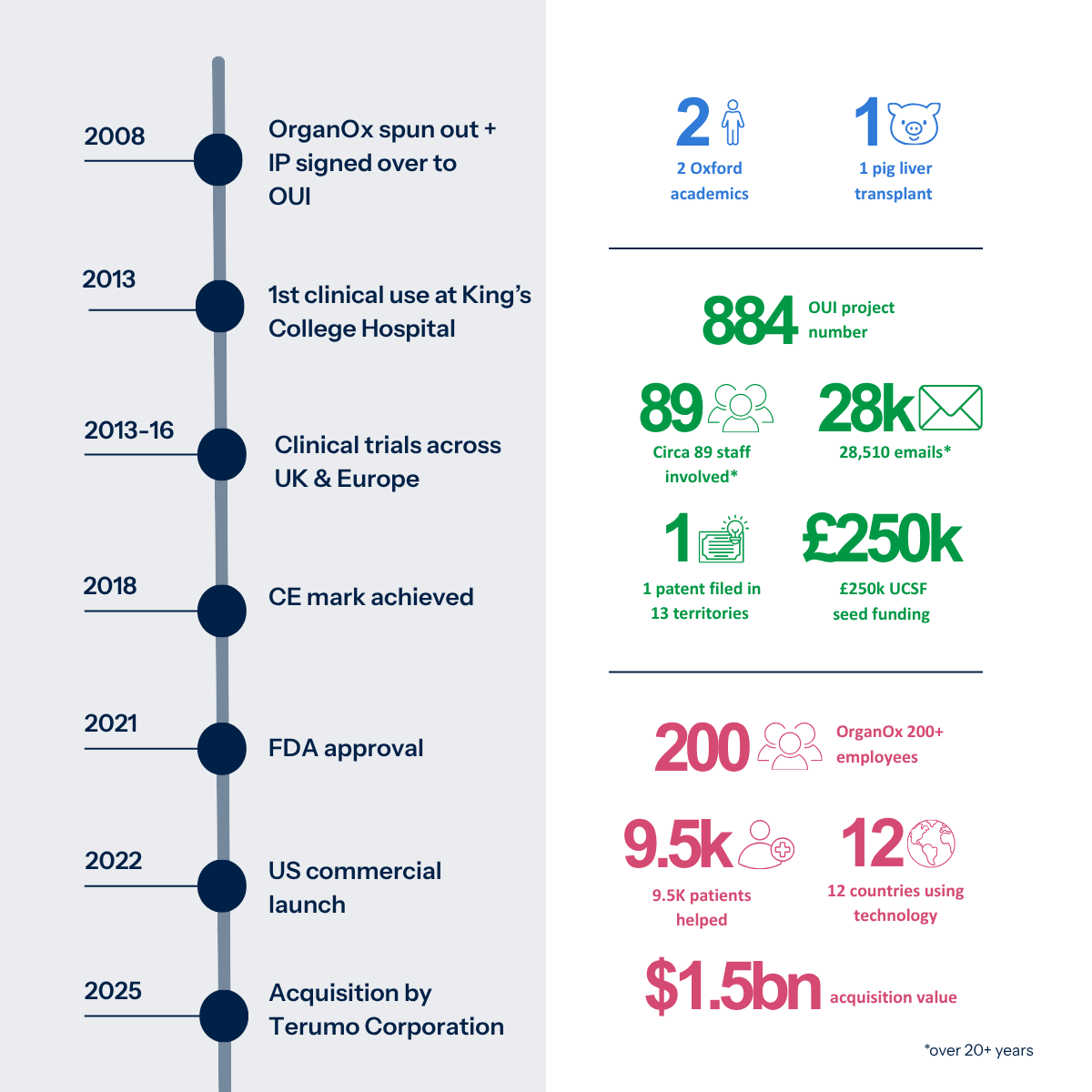
From Project 884 to a better future for liver transplantation: Oxford University Innovation’s journey with OrganOx
Where discovery meets purpose

In a basement laboratory in Oxford, a pig’s liver was being kept alive by warm, oxygenated blood pumped through a handmade machine. What looked like a curious experiment was, in fact, the spark of a medical revolution.
For Oxford University Innovation (OUI), that spark marked the start of a two-decade partnership turning pioneering research into life-saving reality.
At the time (in the mid-2000s), liver transplantation faced an urgent problem: too few donor organs, too many patients dying while waiting, and too many retrieved livers being discarded because surgeons had no reliable way to assess their viability. Around one in four people on the UK waiting list never received a transplant, and patients were more likely to die while waiting than to receive one.
It was against that backdrop that two Oxford academics – Professor Constantin Coussios, from the newly formed Institute of Biomedical Engineering, and Professor Peter Friend, from the Nuffield Department of Surgical Sciences – were exploring how to sustain organs in a functioning state outside the body. Drawing on their combined engineering and surgical expertise, and building on several years of experiments with colleagues Andrew Butler and Mike Rees at the University of Cambridge, they achieved something unprecedented: keeping a liver functioning for three days.
That demonstration of a liver making bile outside the body, watched by potential investors, proved that the idea worked and went on to form the basis of OrganOx, a company now saving and improving lives around the world.
‘That was a significant ‘live’ demonstration of the technology’s capability’, said Colin Story, who managed the project for OUI at the time (then Isis Innovation). ‘Alongside successful re-transplant experiments using lower-quality donor livers at Oxford, this provided the evidence needed to form OrganOx and secure venture investment in 2008.’
In 2011, Colin would join OrganOx as Operations Director, when the company had just two other staff members in addition to the academic Founders.
For OUI, the early success of that demonstration captured what OUI exists to do: connect Oxford’s world-class knowledge and research with the expertise, funding, and partnerships that enable innovation to thrive.
Turning invention into enterprise
As Oxford University’s innovation partner, OUI works to bridge the gap between academic discovery and real-world application – identifying intellectual property (IP), protecting it, securing translational funding, building teams and supporting business plan development, raising investment for new companies, licensing technology, and supporting consultancy so that knowledge can reach those it can help.
OrganOx became one of the clearest expressions of that mission in action.
‘It started as Project 884, a project amongst many under my management, but it ended up transforming organ transplantation,’ recalled Colin Story.
‘When I first met Peter and Constantin, I was immediately intrigued by the potential for clinical impact. They had built a prototype machine in the basement of the engineering department, the size of a grand piano, and which at the time had to be manually operated. This machine kept a pig’s liver functioning for three days.’
From the outset OUI, recognising both the promise and the complexity of the work, helped Professors Coussios and Friend refine their business plan, navigate patents, recruit founding CEO Les Russell to complementing the academic Founders’ scientific and clinical leadership, and secure early investment.
An award of £250k from OUI’s University Challenge Seed Fund (UCSF) provided essential proof-of-concept funding – demonstrating that the technology could sustain organs and attracting external investors. Proof-of-concept funding like this is often the vital step that turns breakthrough research into a viable enterprise.
‘For Peter and I, as first-time Founders, OUI provided a vital guide and partner through the fundraising ecosystem and the journey to company formation’ said, Professor Constantin Coussios, Co-Founder of OrganOx.
‘First exploring licensing opportunities, then firmly landing on the informed decision that OrganOx was definitely a spinout, the OUI team ensured the IP portfolio was adequately protected and secured on both sides of the Atlantic to enable company formation. They helped us navigate the fundraising ecosystem both with early-stage funding and introductions to our founding investors, and were pivotal in helping us identify and partner with our extraordinary funding CEO, Dr Les Russell.’
Much of this work was invisible to the outside world: drafting and negotiating agreements, processing invoices, and maintaining data integrity. These are the activities that make innovation possible – the practical work behind the scenes that ensures the IP is well protected and able to support creative ideas to progress towards new products and services.
That early support helped unlock a tranched £1.5 million seed investment in 2008 from Technikos, Oxford Technology Management Ltd (later Longwall Ventures) and others.
‘Oxford University Innovation helped transform OrganOx from a promising research concept into a structured spinout, laying the foundation for its later development into a successful commercial enterprise with global impact,’ said Craig Marshall, current CEO of OrganOx.
As OrganOx set to work developing the device and testing it through clinical trials and regulatory approvals to market, OUI’s involvement continued as the company grew year on year. OUI filed and managed the patents – including navigating through a tricky debate with the examiners for the US patent application that Professor Coussios later described as pivotal – and drafted, signed and managed the licence agreement enabling OrganOx to commercialise University intellectual property and associated know-how. OUI managed the University’s shareholding on its behalf.
Crucially, OUI was able to invest alongside external partners from Series A onwards, ensuring governance kept pace with expansion whilst remaining true to the aspirations of academic entrepreneurship. OUI’s investment approach enabled the University to maintain a meaningful stake in OrganOx through to exit, with returns reinvested into research and innovation. This creates a cycle of funding that supports the next generation of Oxford companies.
‘Over 20 years, Oxford University Innovation has worked to enable OrganOx’s success, with the expertise of many people playing their part – from funding and patents to licensing and shareholder support, as well as all the back-office work of handling data, processing invoices and developing marketing stories,’ said Mairi Gibbs, CEO of OUI.
‘OrganOx shows what happens when brilliant cross-disciplinary research joins forces with dedicated, expert technology transfer to pursue an important long-term goal,’ added Mairi. ‘It’s a story built on partnership and belief – and it reminds us why our work matters. Every idea we help shape has the potential to improve lives, create new industries, and inspire the next generation of Oxford innovators.’
Building on some early support from the NIHR Oxford Biomedical Research Centre, the first clinical use of the OrganOx metra® system took place at King’s College Hospital, London in 2013, and was supported by a global press release by the University. Between 2013 and 2016, OrganOx ran clinical trials across the UK and Europe, achieving full CE mark certification in 2018.
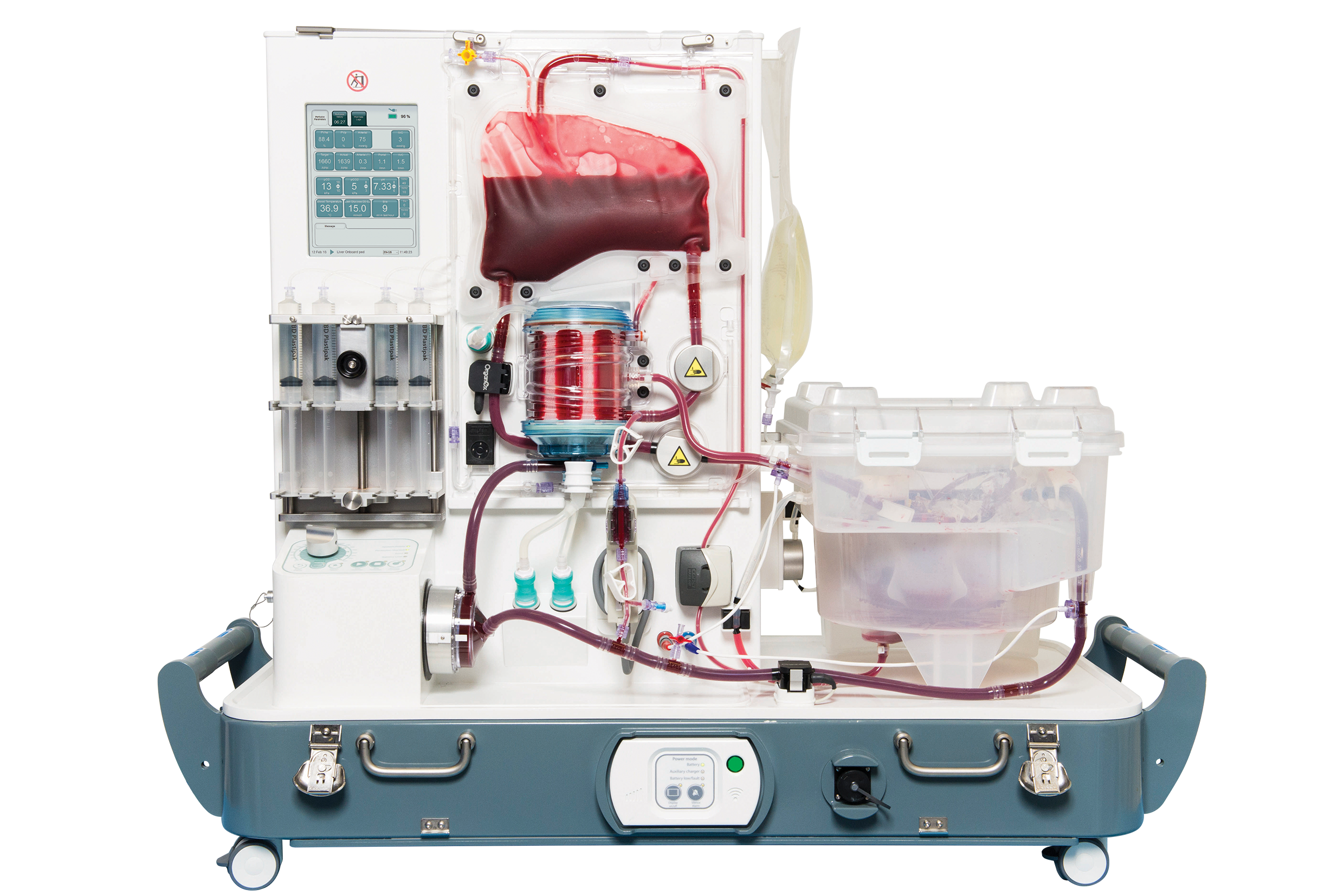
The OrganOx metra® pumps warm, oxygenated blood through donor livers at body temperature, allowing surgeons to assess organ health in real time. Transplants can now be planned rather than performed as emergencies, increasing safety and success rates. After successful US trials, the technology gained FDA approval in 2021 and launched commercially in the US in 2022, where it today supports nearly a third of all liver transplants.
From a small office with three employees and two academic Founders who remained full-time University of Oxford employees throughout the journey, OrganOx has grown into a company employing more than 200 people worldwide, with headquarters at Oxford Business Park. In 2024 it opened a new Research & Development centre, and in early 2025 it won the MacRobert Award – the UK’s top engineering prize, run by the Royal Academy of Engineering, recognising technological innovation with societal and commercial impact.
Throughout, OUI remained a steadfast partner – leading licensing and IP, managing the University’s equity and investment, and celebrating the success of a team whose vision began in Oxford’s labs.
From Project 884 to a better future
OUI’s vision is ‘a better future through innovation from the University of Oxford’. The story of OrganOx shows what that vision looks like in practice.
To date, the OrganOx metra® system has helped more than 9,500 patients receive liver transplants, saving 12 lives per day and rapidly rising. By keeping organs warm and functioning, it has expanded the pool of viable donations, reduced emergency procedures, and generated significant healthcare savings and economic impact across 12 countries on four continents.
In leading transplant centres, the technology has increased the number of liver transplants by 30–50%, reduced waiting times to around 14 days, and more than halved deaths on the waiting list to below 6%. Equally importantly, the technology has been shown to be cost-efficient across healthcare systems, by virtue of increasing transplants and reducing the overall cost of care for patients.
This impact reaches beyond hospitals and lives saved. Every job at OrganOx contributes to a growing ecosystem of engineers, clinicians, and entrepreneurs advancing medical technology from Oxford to the world.
In October 2025, OrganOx was acquired by Terumo Corporation for $1.5 billion – the largest ever purchase of an Oxford University spinout and one of the most significant venture capital exits in UK university history. This success delivers meaningful returns to the University, enabling reinvestment into new research, innovation, and the academics whose ideas shape OUI’s shared future.
For OUI, this milestone represents more than financial achievement, it’s a clear demonstration of the Theory of Change methodology that guides its work. This methodology defines how the University’s inputs (its knowledge and research) become impact through OUI’s activities: including identifying IP, securing funding, licensing, forming companies, and nurturing them to maturity and impact at scale.
This pathway – from idea to impact – is the essence of IP and knowledge transfer.
When OUI first logged Project 884 in its system two decades ago, it was just one of hundreds of research disclosures. But, through persistence, partnership, and belief, it became a global enterprise that has changed how the world performs liver transplants.
OrganOx is proof of what happens when Oxford’s ideas meet OUI’s enabling expertise – transforming discovery into delivery, knowledge into change, and possibility into a better future.